



Το έκθεμα του μήνα για τον Σεπτέμβριο 2025
Κάθε μήνα οι επισκέπτες του μουσείου μας επιλέγουν το έκθεμα
που τους εντυπωσίασε περισσότερο. Αυτό που ξεχώρισαν για τον μήνα Σεπτέμβριο
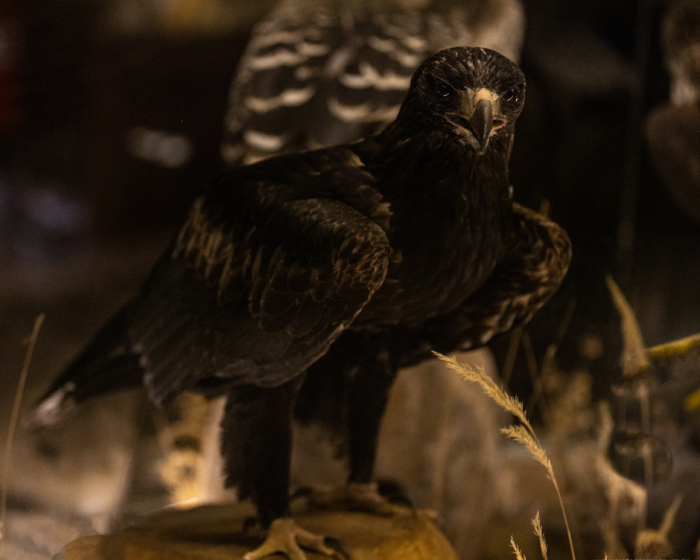
ήταν ο Σφήνουρος Αετός ή Αετός της Αυστραλίας (Aquila audax).
Ο Σφήνουρος Αετός είναι το μεγαλύτερο αρπακτικό πουλί της
Αυστραλίας. Πήρε το όνομά του από το σχήμα της ουράς του, που θυμίζει σφήνα.
Συναντάται στην Ωκεανία και σε περιοχές της Νοτιοανατολικής Ασίας. Με άνοιγμα φτερών
που μπορεί να ξεπεράσει τα 2,3 μέτρα και μήκος σώματος περίπου 1 μέτρου,
θεωρείται ένας από τους μεγαλύτερους αετούς παγκοσμίως. Ο μεγαλύτερος Σφήνουρος
αετός που έχει καταγραφεί, είχε άνοιγμα φτερών 2,84 μέτρα! Ο χρωματισμός των
φτερών του παρουσιάζει ποικιλομορφία, όμως κυμαίνεται μεταξύ σκούρου καφέ ως μαύρο.
Τα νεαρά άτομα έχουν πιο ανοιχτούς τόνους και ρίγες στο πτέρωμα.
Είναι ένα ευπροσάρμοστο είδος. Συναντάται σε ανοικτά δάση,
σαβάνες, λιβάδια, παρυφές ερήμων, ορεινά
λιβάδια και περιοχές με χαμηλή βλάστηση, ακόμη και κοντά σε πόλεις ή βοσκοτόπια.
Φωλιάζει σε ψηλά δέντρα με καλή ορατότητα στην περιοχή. Οι φωλιές του μπορεί να
φτάσουν τα 2-5 μέτρα σε βάθος και πλάτος.
Τρέφεται με μικρά ερπετά, πτηνά, θηλαστικά, ακόμη με μωρά καγκουρό
(!), ενώ συχνά καταναλώνει πτώματα. Έχουν καταγραφεί περιπτώσεις όπου επιτίθεται
σε drones, αλεξίπτωτα
πλαγιάς ή μικρά αεροπλάνα, όταν αντιλαμβάνεται εισβολή στην επικράτειά του.
Είναι μονογαμικό είδος και τα ζευγάρια παραμένουν μαζί για χρόνια – συχνά για όλη τους τη ζωή. Η περίοδος αναπαραγωγής του εκτείνεται από Ιούλιο ως Δεκέμβριο, αλλά εξαρτάται από την περιοχή. Το θηλυκό γεννά συνήθως δύο αβγά, τα οποία επωάζονται και από τους δύο γονείς. Οι νεοσσοί εκκολάπτονται έπειτα από περίπου 45 μέρες. Για τους πρώτους έξι μήνες, εξαρτώνται πλήρως από τους γονείς τους για τροφή.
Στη φωτογραφία βλέπετε έναν Σφήνουρο Αετό στη συλλογή του Μουσείου.